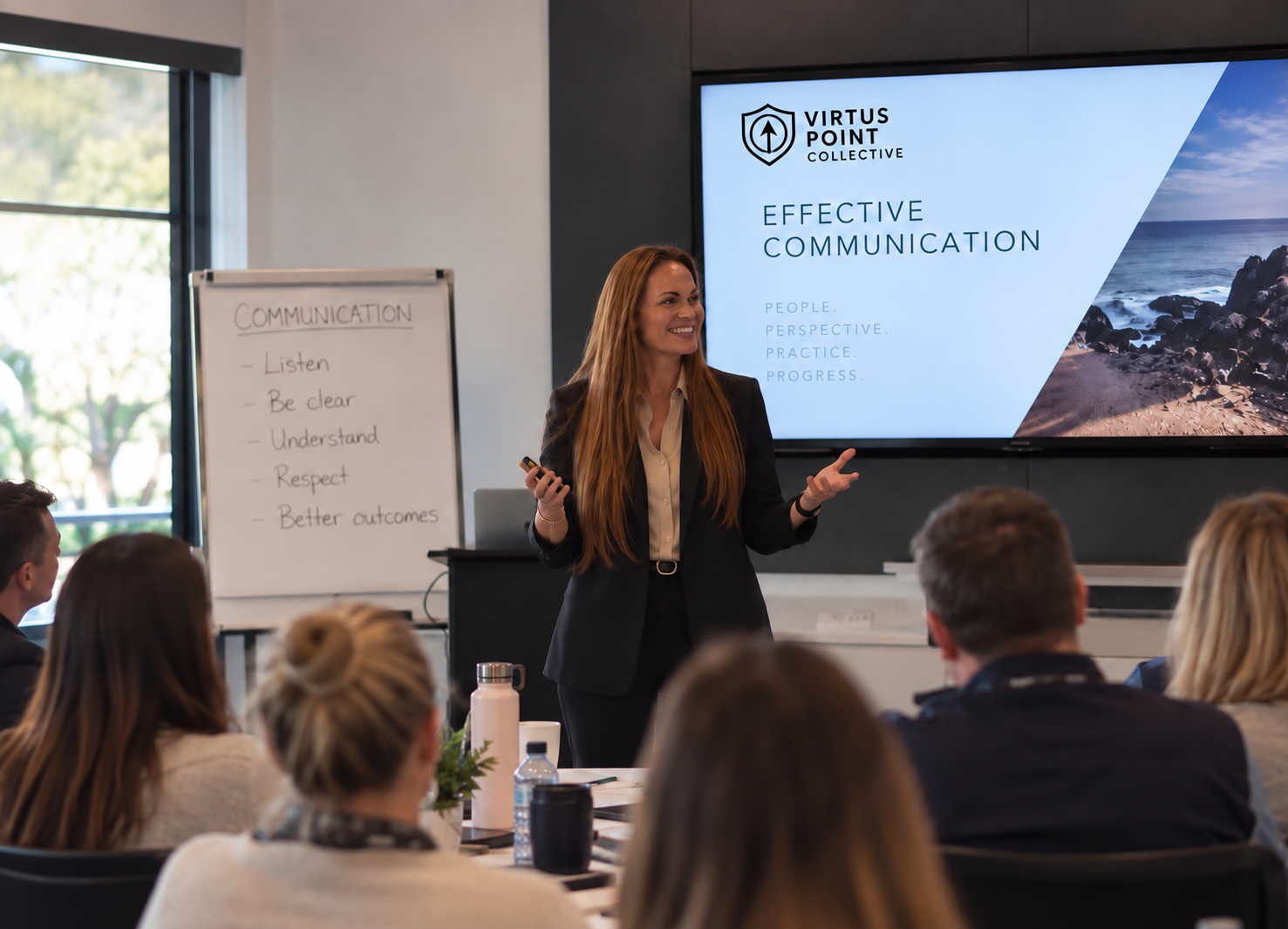
The difference between conflict and cooperation often comes down to how the conversation is handled.
At Virtus Point Collective, we believe everyone can learn to communicate under pressure. These aren’t elite skills reserved for specialists, they’re life skills for anyone who wants to strengthen relationships and create better outcomes.
Our training is built on proven, evidence-based frameworks like the FBI’s Behavioural Change Stairway Model and the PEACE model of investigative interviewing. But these tools aren’t about interrogation, they’re about fairness, clarity, and connection. They teach you how to listen deeply, ask better questions, and guide a conversation toward understanding and trust.
Through practical workshops, resources, and real-world examples, we help people approach difficult conversations with calm and confidence. Because when communication works, everything else follows.
Our Services
-
Build the confidence to communicate, connect and influence — even under pressure.
Effective communication is more than choosing the right words. It's about understanding human behaviour, building trust, recognising emotional responses and knowing how to guide challenging conversations towards positive outcomes.
Through proven behavioural frameworks, practical activities and real-world scenarios, participants learn to:
Understand the psychology behind communication — explore how emotions, perceptions, assumptions and unconscious biases influence the way people communicate and respond.
Apply the Behavioural Change Stairway Model — understand how active listening, empathy, rapport, influence and behavioural change work together to create meaningful outcomes.
Develop advanced active listening skills — use purposeful questioning, reflection, paraphrasing and silence to better understand others.
Build trust and genuine rapport — create environments where people feel heard, respected and more willing to engage.
Recognise the power of non-verbal communication — understand how body language, tone, facial expressions and physical positioning affect conversations.
Identify barriers to effective communication — recognise common communication traps, defensiveness, assumptions and power imbalances.
Navigate conflict and challenging behaviour — apply practical de-escalation techniques while maintaining confidence, professionalism and emotional control.
Use language that encourages cooperation — identify trigger phrases, reduce defensiveness and replace confrontational language with constructive alternatives.
Influence behaviour without relying on authority — encourage cooperation, accountability and positive behavioural change through connection rather than control.
Turn learning into practical workplace skills — apply techniques through realistic scenarios, group discussion and guided reflection.
Create a Best-Practice Communication Checklist — develop a practical resource tailored to your organisation that supports lasting improvements beyond the workshop.
The outcome? More confident communicators, stronger professional relationships, reduced conflict and people equipped to manage the conversations that matter most.
Because effective communication isn't about controlling the conversation. It's about creating the conditions for a better outcome.
-
The way we ask questions can determine the quality of the answers we receive, the trust we establish and the fairness of the decisions that follow.
Whether conducting an internal investigation, responding to a workplace complaint, managing a sensitive disclosure or gathering information following an incident, the ability to interview effectively is an essential professional skill.
Built around the internationally recognised P.E.A.C.E. investigative interviewing framework, this practical workshop equips participants with a structured, ethical and defensible approach to gathering accurate information while maintaining fairness, transparency and respect.
Participants will develop the knowledge and practical skills to:
Understand and apply the P.E.A.C.E. framework — explore the five stages of Planning and Preparation, Engage and Explain, Account, Closure and Evaluation, and how each contributes to a fair and effective interview.
Plan and prepare for investigative conversations — identify interview objectives, consider available information, recognise potential risks and develop a structured approach before conducting an interview.
Build rapport and establish trust — create an environment that encourages open communication while maintaining professional boundaries, neutrality and impartiality.
Master effective questioning techniques — distinguish between open, closed, probing and leading questions, and understand how question selection affects the accuracy and reliability of information.
Recognise and minimise cognitive bias — identify assumptions, confirmation bias and premature conclusions that can compromise information gathering and decision-making.
Apply trauma-aware interviewing principles — recognise how distress, vulnerability and emotional responses may affect communication, recall and engagement, and adapt interviewing practices accordingly.
Gather accurate and reliable accounts — encourage individuals to explain events in their own words, clarify inconsistencies and explore information without contaminating or influencing their responses.
Maintain procedural fairness and ethical integrity — understand the importance of impartiality, transparency, respectful treatment and providing individuals with a fair opportunity to be heard.
Manage sensitive and challenging interviews — maintain professionalism when faced with defensiveness, distress, reluctance or conflicting information.
Recognise safeguarding and escalation responsibilities — identify circumstances where an interview should be paused, discontinued or referred to an appropriately qualified person or external authority.
Document information clearly and defensibly — develop accurate records that distinguish facts, observations and interpretations and support transparent decision-making.
Close and evaluate interviews effectively — summarise key information, explain next steps, identify gaps and reflect on the quality and fairness of the interview process.
Apply learning through realistic scenarios — practise structured interviewing and information-gathering techniques using practical situations relevant to your organisation.
Beyond the Interview
Resolving with P.E.A.C.E. is not about extracting admissions, proving assumptions or simply getting someone to talk.
It is about gathering information ethically, testing understanding, reducing the risk of bias and ensuring that people are treated fairly throughout the process.
The outcome? More confident interviewers, better-quality information, stronger procedural integrity and decisions that can withstand scrutiny.
Because the quality of a decision depends on the integrity of the process used to reach it.
-
The complete communication & investigation masterclass! Understand Behaviour. Navigate Conflict. Interview with Integrity.
Two powerful frameworks. One comprehensive learning experience.
Every organisation faces conversations where the stakes are high. Workplace complaints, challenging behaviour, sensitive disclosures, interpersonal conflict, investigations and difficult decisions all demand more than good intentions.
They demand the ability to understand people, communicate with confidence, manage emotional responses and gather information fairly, accurately and without bias.
This comprehensive eight-hour masterclass brings together Virtus Point Collective's Authentic Communication and Resolving with P.E.A.C.E. programs into one immersive professional development experience.
Combining behavioural psychology, practical communication techniques, conflict resolution strategies and structured investigative interviewing, this program equips participants with the knowledge, confidence and practical tools to navigate complex conversations from the first interaction through to informed, defensible decision-making.
By the end of this your team will:
Understand Human Behaviour & Communication
Explore the psychology behind human communication, including emotional responses, assumptions, perceptions and behavioural triggers.
Understand how stress, fear, defensiveness and power imbalances influence communication and decision-making.
Recognise the impact of body language, tone, facial expressions and non-verbal communication.
Identify common communication barriers, unconscious bias and behaviours that undermine trust.
Build Trust, Rapport & Influence
Apply the Behavioural Change Stairway Model to understand the relationship between active listening, empathy, rapport, influence and behavioural change.
Develop active listening skills, including reflection, paraphrasing, purposeful silence and effective questioning.
Establish rapport and psychological safety without compromising professional boundaries.
Understand how respectful communication can encourage cooperation, accountability and positive behavioural change.
Navigate Conflict & Challenging Conversations
Apply practical de-escalation strategies to manage emotionally charged situations.
Recognise early warning signs of escalating conflict and respond appropriately.
Identify trigger phrases and replace them with language that encourages cooperation rather than resistance.
Maintain professionalism, emotional awareness and composure under pressure.
Navigate difficult conversations with clarity, confidence and respect.
Master the Foundations of Ethical Investigative Interviewing
Understand and apply the five stages of the P.E.A.C.E. investigative interviewing framework: Planning and Preparation, Engage and Explain, Account, Closure and Evaluation.
Prepare for sensitive interviews by establishing clear objectives, identifying risks and considering the needs of those involved.
Use open, neutral and non-leading questions to obtain accurate, reliable information.
Apply TEDS questioning techniques and free-recall principles to encourage detailed accounts without unnecessarily influencing responses.
Recognise confirmation bias, assumptions and questioning practices that can compromise investigative integrity.
Apply trauma-aware principles when interviewing individuals experiencing distress or vulnerability.
Strengthen Procedural Fairness & Accountability
Understand the importance of impartiality, transparency and procedural fairness when gathering information.
Distinguish between facts, observations, interpretations and assumptions.
Document conversations and interviews accurately, ethically and defensibly.
Recognise safeguarding, duty-of-care and escalation responsibilities.
Close interviews professionally, clarify expectations and explain appropriate next steps.
Evaluate interview processes to identify gaps, improve practices and support sound decision-making.
Put Learning into Practice
Participate in realistic, scenario-based activities relevant to your workplace.
Apply communication and investigative interviewing principles to challenging situations.
Reflect on individual communication habits and identify opportunities for improvement.
Collaboratively develop a Best-Practice Communication & Interviewing Checklist tailored to your organisation.
Leave with practical tools, techniques and resources to reinforce learning beyond the workshop.
One Program. Skills That Work Together.
Effective communication and investigative interviewing are not separate disciplines. They share a foundation of listening, empathy, objectivity, fairness and professional judgement.
This masterclass brings those skills together, helping participants understand not only what to say and ask, but why, when and how.
The Outcome
Participants leave better equipped to:
Communicate confidently in complex and emotionally charged situations.
Build trust and cooperation while maintaining professional boundaries.
Recognise and manage conflict before it escalates.
Gather information through structured, ethical interviewing practices.
Reduce bias and strengthen the fairness of workplace processes.
Make more informed decisions supported by accurate information and defensible practices.
Better conversations lead to better information. Better information supports better decisions. And better decisions build stronger
Add-Ons & Options
-
Understand the challenges before the training begins.
A confidential pre-workshop survey designed to identify participants' experiences, confidence levels and common communication or conflict challenges. Responses are analysed to identify key themes, emerging issues and opportunities for development.
Organisations receive a tailored insights report highlighting findings and recommendations, allowing workshop content to be adapted to the needs of their people.
-
Turn new skills into everyday practice.
A personalised 60-minute online coaching session to reinforce workshop learning and support its application in real workplace situations.
Participants can discuss challenging conversations, explore barriers to implementation and receive practical guidance to strengthen their confidence, communication and conflict-resolution skills.
Available for individuals or small leadership groups.
-
See how communication works in practice.
An independent observation and review of a workplace meeting, facilitated role-play, leadership discussion or other agreed communication activity.
Using structured observation criteria, Virtus Point Collective evaluates communication practices, interpersonal dynamics, conflict management and opportunities for improvement.
A detailed written report provides constructive feedback, identifies strengths and areas for development, and offers practical, actionable recommendations.
-
Item descriptionRevisit the learning. Refine the skills. Reinforce the change.
A focused two-hour session designed to consolidate key workshop concepts, address questions that have emerged in practice and strengthen participants' confidence.
Through interactive discussion, scenario-based activities and guided reflection, participants revisit essential techniques and practise applying them to current workplace challenges.
Ideal for organisations wanting to maintain momentum and embed lasting behavioural change.
-
A targeted review of how leaders communicate expectations, manage disagreement, deliver feedback and respond to conflict. Drawing on agreed consultation, surveys or structured interviews, organisations receive a practical assessment highlighting strengths, potential risks and opportunities to improve communication and trust.
-
Confidential, practical preparation for an upcoming challenging conversation. Participants receive guidance on structuring their approach, anticipating reactions, choosing appropriate language and managing emotional responses. Ideal for performance discussions, workplace grievances and sensitive leadership conversations.
60 - 90 minutes

“The goal is not to give people a script. It is to build the judgement and confidence to meet the moment.”
The Virtus Point Difference
Practical skills for conversations that matter.
Real conversations don’t follow a script.
Our sessions bring established frameworks to life through realistic practice, helping participants build the confidence to respond when conversations become challenging.
Each session equips participants with practical language, tools and techniques they can draw on under pressure.
Tailored to your people, roles and working environment
Built around realistic scenarios, reflection and guided feedback
Grounded in fairness, trust and procedural integrity
Focused on addressing difficult issues and reducing conflict
Who we work with
Government and public sector
Businesses and corporate teams
Schools and education providers
Community and not-for-profit organisations
Healthcare and disability services
Clubs, committees and volunteer groups
Sport and recreation organisations
Leaders, managers and frontline staff
Wherever people work together, conversations matter. We help make them more effective.
Meet Shannon Britten
Shannon brings more than 25 years of professional experience across investigation, education, communication and high-pressure operational environments. She has extensive experience designing and delivering adult education, facilitating scenario-based learning, conducting investigative interviews and developing practical communication skills for challenging situations
She has worked across leadership, training, and community settings, where communication can be the difference between progress and breakdown. From workplaces navigating tough discussions, to schools partnering with families, to teams resolving conflict under pressure, Shannon has seen how powerful and fragile dialogue can be.
That breadth of professional and lived experience gives Shannon a valuable perspective on what it feels like on both sides of a challenging conversation
Shannon founded Virtus Point Collective to bridge that gap. Her mission was simple but powerful: to turn theory into practice and pressure into clarity. Virtus Point Collective delivers practical, adaptable tools that help professionals communicate with fairness, empathy, and confidence — so that even the toughest conversations strengthen relationships instead of breaking them.